To say you are grateful in Mandarin Chinese, use 感激 (gǎnjī): 我很感激你。 (Wǒ hěn gǎnjī nǐ.) means "I'm very grateful to you." For a straightforward "thank you", use 谢谢 (xièxie). 感谢 (gǎnxiè) also expresses thanks and works when you want to name what someone did for you. HSK Academy gives the readings and meanings of 感激, 谢谢 and 感谢.
The useful next step is not collecting ten more ways to say thanks. It is finishing the sentence: grateful to whom, and for what?
Choose a sentence, not just a translation
| What you want to say | Mandarin | Pinyin |
|---|---|---|
| Thank you. | 谢谢你。 | Xièxie nǐ. |
| I'm very grateful to you. | 我很感激你。 | Wǒ hěn gǎnjī nǐ. |
| Thank you very much. | 非常感谢你。 | Fēicháng gǎnxiè nǐ. |
These are useful starting points, not three rigid levels of politeness. Their meanings overlap: 感激 names being grateful, while 谢谢 and 感谢 let you thank someone directly. You do not need to squeeze all three into one message.
- xiè谢xie谢HSK1
to thank; thanks
- Example感谢gǎn xiè(express) thanks; gratitude
- gǎn感xiè谢HSK4
(express) thanks; gratitude
- Example谢谢xiè xieto thank; thanks
In 我很感激你, the person feeling grateful comes first: 我 (wǒ), "I". The person receiving that gratitude comes after 感激: 你 (nǐ), "you". Keep the sentence together rather than inserting 是 (shì) just because English has "am".
To address someone more respectfully, replace 你 with 您 (nín): 我很感激您。 (Wǒ hěn gǎnjī nín.) "I'm very grateful to you." HSK Academy identifies 您 as the courteous form of "you".
Add the help you are thankful for
帮助 (bāngzhù) can mean both "to help" and "help" or "assistance". That gives you two ways to thank the same person:
- 谢谢你帮助我。 (Xièxie nǐ bāngzhù wǒ.) Thank you for helping me.
- 谢谢你的帮助。 (Xièxie nǐ de bāngzhù.) Thank you for your help.
In the first, 你帮助我 (nǐ bāngzhù wǒ) says what happened: "you help me". In the second, 你的帮助 (nǐ de bāngzhù) names "your help". Both thank the listener. The little 的 (de) changes how the reason is built, not who deserves the thanks.
- zhī支chí持HSK4
to be in favor of; to support
- Example坚持jiān chíto persevere with; to persist in
Try the noun pattern with 感谢 too:
感谢你的帮助。 (Gǎnxiè nǐ de bāngzhù.) Thank you for your help.
Then change the reason, not the whole sentence. 支持 (zhīchí) means "support", so you can write:
感谢你的支持。 (Gǎnxiè nǐ de zhīchí.) Thank you for your support.
For a respectful message with stronger thanks:
非常感谢您的帮助。 (Fēicháng gǎnxiè nín de bāngzhù.) Thank you very much for your help.
Finish the exchange
After someone thanks you, a standard reply is 不客气。 (Bú kèqi.) "You're welcome." It is a response to thanks, not another way to say "I'm grateful". See HSK Academy's 不客气 entry.
Here is a short exchange to practise:
- A: 谢谢你的帮助。 (Xièxie nǐ de bāngzhù.) Thank you for your help.
- B: 不客气。 (Bú kèqi.) You're welcome.
If you need to ask for that help first, our guide to please in Chinese shows how to make the request.
Make the choice before flipping a card
Try these without looking back. The suggested answers are not the only possible sentences.
- A friend helped you. Complete "Thank you for helping me": 谢谢你___我。 (Xièxie nǐ ___ wǒ.)
- Keep the same meaning but use "your help": 谢谢你___帮助。 (Xièxie nǐ ___ bāngzhù.)
- Say "I'm very grateful to you" using 感激 (gǎnjī).
- Someone thanks you. Which is the reply: 谢谢 (xièxie) or 不客气 (bú kèqi)?
Suggested answers:
- 帮助 (bāngzhù): 谢谢你帮助我。 (Xièxie nǐ bāngzhù wǒ.)
- 的 (de): 谢谢你的帮助。 (Xièxie nǐ de bāngzhù.)
- 我很感激你。 (Wǒ hěn gǎnjī nǐ.)
- 不客气。 (Bú kèqi.) You're welcome.
Now recall the individual words, then use one in a complete thank-you.
感激Tap to reveal
gǎn jīto be grateful; to appreciate
感谢Tap to reveal
gǎn xiè(express) thanks; gratitude
谢谢Tap to reveal
xiè xieto thank; thanks
帮助Tap to reveal
bāng zhùassistance; aid
支持Tap to reveal
zhī chíto be in favor of; to support
不客气Tap to reveal
búkèqiyou're welcome; don't mention it
Got it: 0 of 6
When a relevant word appears on Lock In's Lock Screen widget, use it as a cue to thank someone in a sentence. For 帮助, try both "helping me" and "your help" before looking back here. That is a speaking exercise you do yourself; the widget does not check your sentence.
For more words to build around these phrases, use our HSK 1 words grouped for daily use.
Further reading
- HSK Academy: examples with 谢谢, including thanks followed by a person's action or a noun phrase.
- HSK Academy: examples with 感谢, including a respectful thank-you for help.
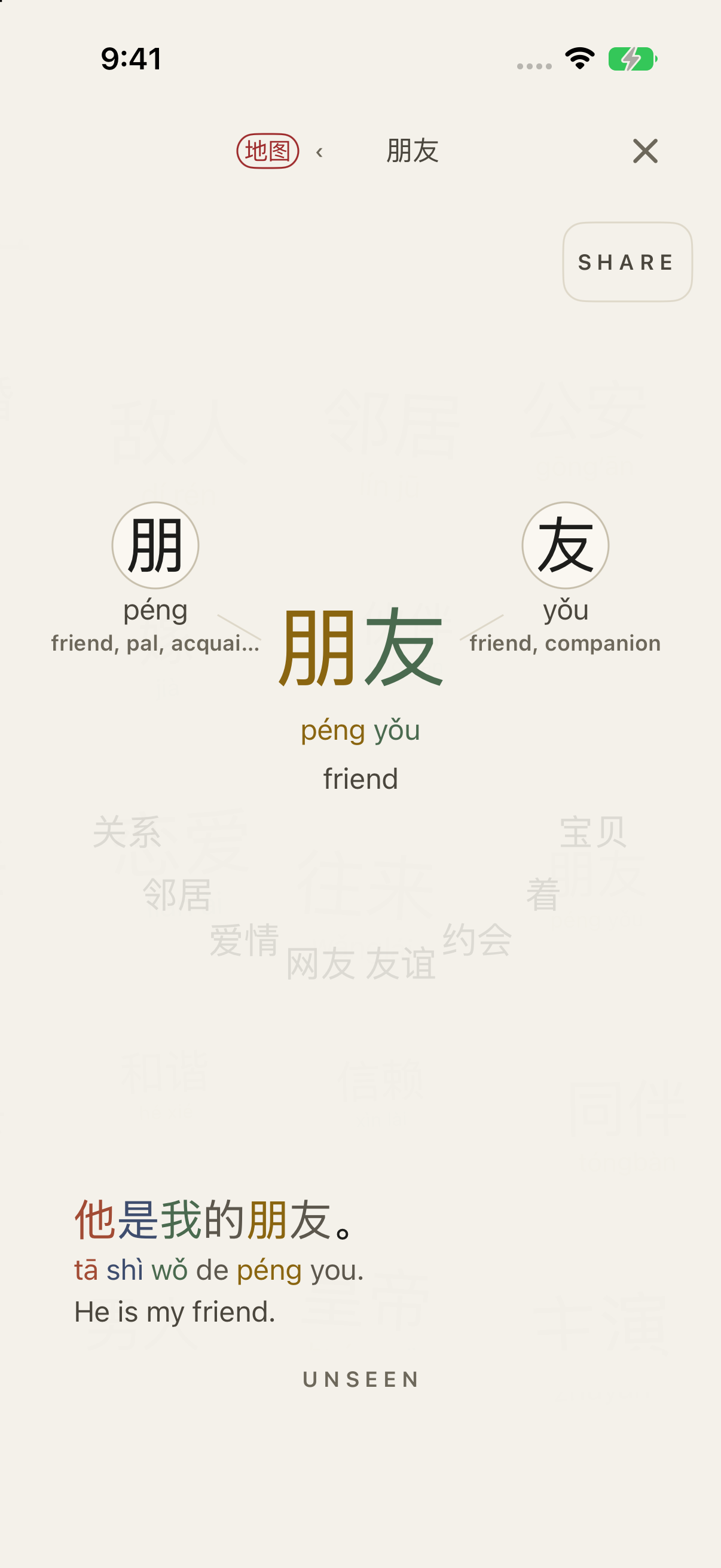
Every word opens like this in Lock In
Characters, readings and a real sentence, on your lock screen.

Word data: CC-CEDICT, CC BY-SA 4.0, adapted.