To order food in Mandarin Chinese, say 我要… (wǒ yào…), "I'd like…", followed by the food. If you cannot read the dish name, point to it and say 我要这个。 (Wǒ yào zhège.) "I'd like this one." To specify a portion, use 我要一份这个。 (Wǒ yào yí fèn zhège.) "I'd like one portion of this."
Here is how to carry that order through a simple sit-down meal: get the menu, choose food and quantities, explain your spice preference, check the order and ask to pay. These are Mandarin phrases, not Cantonese.
Get a table and the menu
You may hear 几位? (Jǐ wèi?), "How many people?" A short answer is 两位。 (Liǎng wèi.) "Two people."
The useful word is 位 (wèi), a polite measure word for people. It counts diners here, not dishes.
Once you have someone's attention, ask:
请给我菜单。 (Qǐng gěi wǒ càidān.) Please give me the menu.
菜单 (càidān) means "menu". If you need to address a server, 服务员 (fúwùyuán) means "server" or "waiter". There is no need to learn a separate word for a waitress.
For more ways to frame a request, see please in Chinese. Here, 请 (qǐng) goes before 给 (gěi), "give".
Build an order you can change
Keep this pattern handy:
我要 + number + measure word + food or drink.
The measure word tells the listener what you are counting: a portion, a bowl or a cup. Use the one that matches your order.
| You want | Say | Pinyin |
|---|---|---|
| One portion of the dish you are pointing at | 我要一份这个。 | Wǒ yào yí fèn zhège. |
| One bowl of rice | 我要一碗米饭。 | Wǒ yào yì wǎn mǐfàn. |
| Two bowls of noodles | 我要两碗面条。 | Wǒ yào liǎng wǎn miàntiáo. |
| Two cups of tea | 我要两杯茶。 | Wǒ yào liǎng bēi chá. |
份 (fèn) counts portions in the first example. 碗 (wǎn) counts bowlfuls, and 杯 (bēi) counts cups or glasses. HSK Academy gives the readings and meanings of 碗 and 杯.
For two bowls or two cups, use 两 (liǎng) rather than 二 (èr). The same 两 works in 两位 (liǎng wèi), "two people". The word after the number keeps the diners separate from their dinner.
米饭 (mǐfàn) is cooked rice; 面条 (miàntiáo) means noodles. Practise swapping just one part: keep "two bowls" and change noodles to rice. Then keep the rice and change two bowls to one.
Ask about spice before ordering
辣 (là) means spicy. Start with a question if you do not know the dish:
这个辣吗? (Zhège là ma?) Is this spicy?
Then choose the request you actually mean:
- 不要辣。 (Bú yào là.) Not spicy, please.
- 少放辣椒。 (Shǎo fàng làjiāo.) Please put in less chili.
These are not the same request. 少 (shǎo) means "less" here, while 辣椒 (làjiāo) is chili pepper. Less chili still leaves some chili. Do not use the second sentence when you mean none.
If you want to ask whether a non-spicy version is possible, try 可以做不辣的吗? (Kěyǐ zuò bú là de ma?) "Can you make it non-spicy?" Ask rather than assuming every dish can be changed.
Listen for the quantity, not just the food
Imagine you ordered two bowls of noodles. The server checks:
一碗面条? (Yì wǎn miàntiáo?) One bowl of noodles?
The food is right, but the quantity is not. Reply:
两碗面条,谢谢。 (Liǎng wǎn miàntiáo, xièxie.) Two bowls of noodles, thank you.
You do not need a long explanation to repair that mix-up. Repeat the correct quantity and food together. If you only catch 面条, do not assume the whole order is right.
If you missed the words altogether, use 请再说一次。 (Qǐng zài shuō yí cì.) "Please say it again." Olle Linge includes this repair phrase in his classroom Mandarin guide; it is useful outside a lesson too.
For a dish that has already arrived but is not yours, 这不是我点的。 (Zhè bú shì wǒ diǎn de.) means "This isn't what I ordered." Then point to the intended item on the menu.
Finish the order, then finish the meal
A server may ask 还要别的吗? (Hái yào bié de ma?), "Anything else?" If you are done ordering, say 不要了,谢谢。 (Bú yào le, xièxie.) "Nothing else, thank you."
Later, when you are ready to pay:
请结账。 (Qǐng jiézhàng.) The bill, please.
结账 (jiézhàng) means to settle the bill. The phrase does not specify a payment method; that is a separate question.
- jié结zhàng账HSK4
to settle the bill
- Example结束jié shùtermination; to finish
Practise a meal with one deliberate mistake
Try this aloud before checking the answers. You and a friend want two bowls of rice and one cup of tea, with no more items after that.
- The server asks 几位? (Jǐ wèi?). Give the number of diners.
- Order the rice and tea. Remember that bowls and cups need different words.
- The server repeats 一碗米饭? (Yì wǎn mǐfàn?). Correct the quantity.
- The server asks 还要别的吗? (Hái yào bié de ma?). Finish ordering.
- After the meal, ask for the bill.
Suggested answers:
- 两位。 (Liǎng wèi.) Two people.
- 我要两碗米饭和一杯茶。 (Wǒ yào liǎng wǎn mǐfàn hé yì bēi chá.) I'd like two bowls of rice and one cup of tea.
- 两碗米饭,谢谢。 (Liǎng wǎn mǐfàn, xièxie.) Two bowls of rice, thank you.
- 不要了,谢谢。 (Bú yào le, xièxie.) Nothing else, thank you.
- 请结账。 (Qǐng jiézhàng.) The bill, please.
Now check the words without the restaurant clues.
菜单Tap to reveal
càidānmenu
米饭Tap to reveal
mǐ fàn(cooked) rice
面条Tap to reveal
miàn tiáonoodles
茶Tap to reveal
chátea; tea plant
碗Tap to reveal
wǎnbowl
辣Tap to reveal
làspicy
结账Tap to reveal
jié zhàngto settle the bill
Got it: 0 of 7
When a food word appears on Lock In's Lock Screen widget, use it as a cue to make an order aloud. Give a quantity, then change it. This is an exercise you do yourself, not a feature that checks your spoken sentence.
For more words to put around your order, use our HSK 1 words grouped for daily use. If your next stop is the front desk rather than a restaurant, practise checking into a hotel in Chinese, including how to keep room counts and nights separate.
Further reading
- HSK Academy: 菜单 and 结账, for the words at either end of the meal.
- Olle Linge, Hacking Chinese: Classroom Mandarin, for asking someone to repeat or explain.
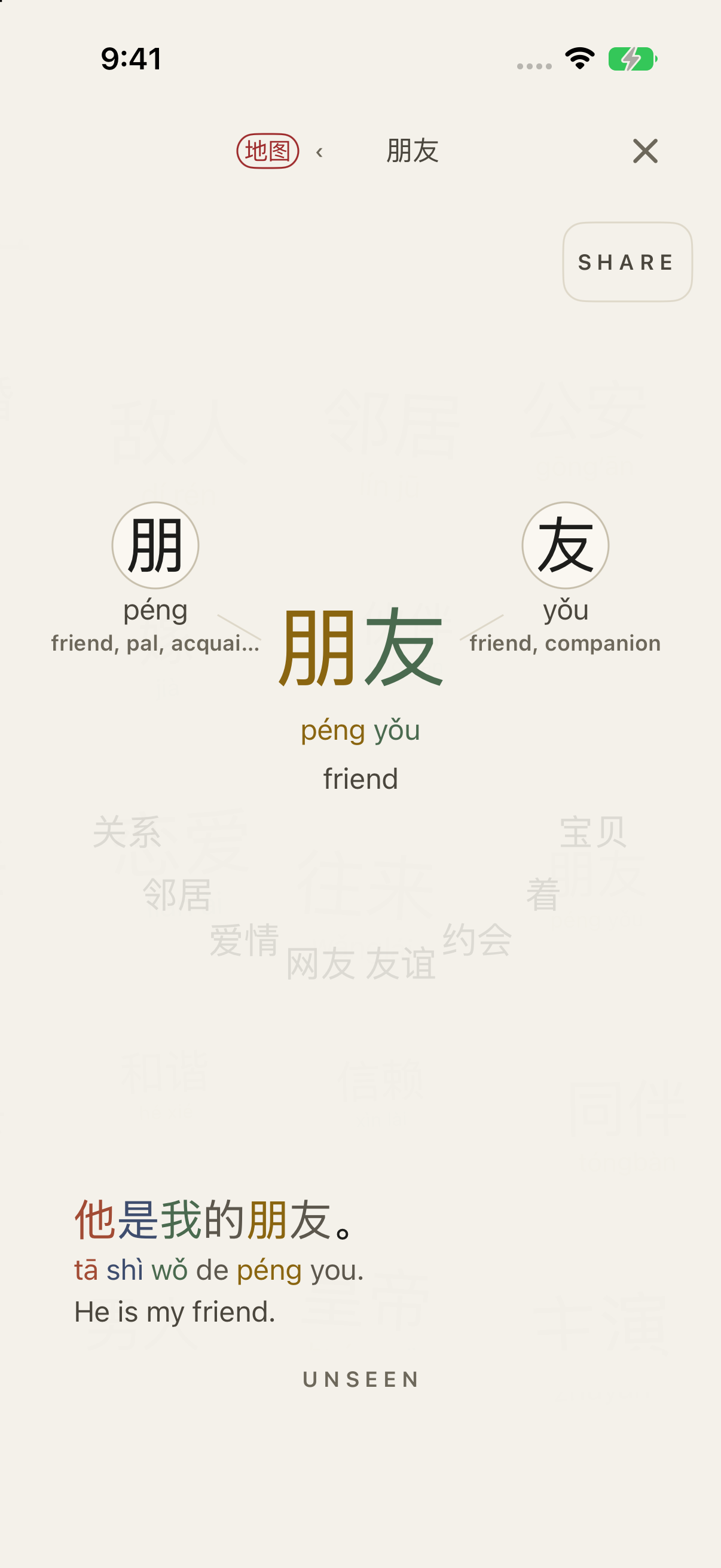
Every word opens like this in Lock In
Characters, readings and a real sentence, on your lock screen.

Word data: CC-CEDICT, CC BY-SA 4.0, adapted.